Projection vs LED walls for simulation
LED walls are getting cheaper every year, and for some jobs they're the right answer. For a wraparound cockpit viewed from one or two metres away, the physics still favours a curved projection surface — here's the honest comparison.
| SimPit curved projection | LED wall | |
|---|---|---|
| Surface geometry | True continuous cylinder — one surface, correct geometry at the eye point | Flat cabinets; "curved" walls are faceted from flat modules |
| Seams | Blend zones you can't find with your eyes | Cabinet joins — alignment and colour matching degrade over time |
| Pixel structure at 1–2 m | ≈0.7 mm pixel spacing on a 3 m / 270° system with three 4K projectors | Affordable pitches (P1.5–P2.5+) show visible pixel grid at cockpit distance; sub‑1 mm pitch is where prices escalate sharply |
| Brightness & eye comfort | Natural out‑the‑window luminance for hours in a dim sim room | Emissive panel designed to fight daylight — fatiguing at close range in a dark room |
| Heat & power at the pilot | Projectors sit behind and above, away from the seat | Kilowatt‑class heat radiating from the surface beside your head |
| Weight & installation | Floor‑standing frame, adjustable on uneven floors, no rigging | Hundreds of kilograms of cabinets plus mounting structure |
| Serviceability | The surface has no electronics to fail; projectors are off‑the‑shelf and replaceable | Dead pixels and module swaps, with batch‑matching colour drift |
A cylinder is not a set of flat panels
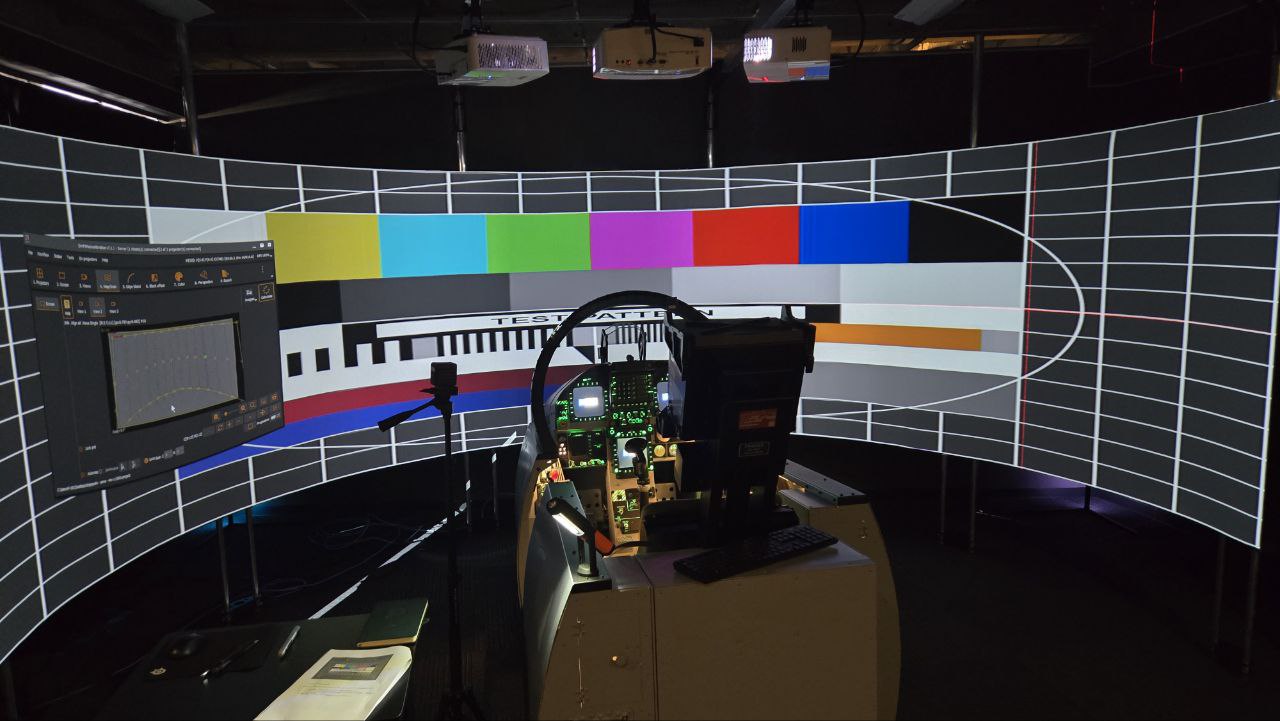
Simulation visuals are generated for a precise eye point, then warped onto the display geometry. On a true cylinder that mapping is exact and continuous — alignment, motion and peripheral cues behave the way they do out a real window.
A "curved" LED wall is built from flat cabinets set at angles. Every facet is a geometric discontinuity the warp has to fight, and every join is a seam that has to be hidden. You can get close. Close isn't what a pilot's peripheral vision responds to.
You sit one metre from a cockpit display
LED wall pricing is quoted per square metre, and the price is set by pixel pitch. At trade-show distances a P2.5 wall looks superb. From a cockpit seat, the pixel grid is plainly visible — and the fine-pitch product that fixes it costs multiples per square metre, then still needs to be faceted around you.
Three 4K short-throw projectors across a 3 m, 270° SimPit screen place pixels roughly 0.7 mm apart — finer than premium fine-pitch LED, on a continuous curve, at a fraction of the cost.

Heat, weight, power, and the room you actually have
An LED wall big enough to wrap a cockpit is an appliance: hundreds of kilograms of cabinets, kilowatts of draw, and all of its heat delivered from the surface right beside the pilot. It usually brings rigging, structural questions, and an air-conditioning bill with it.
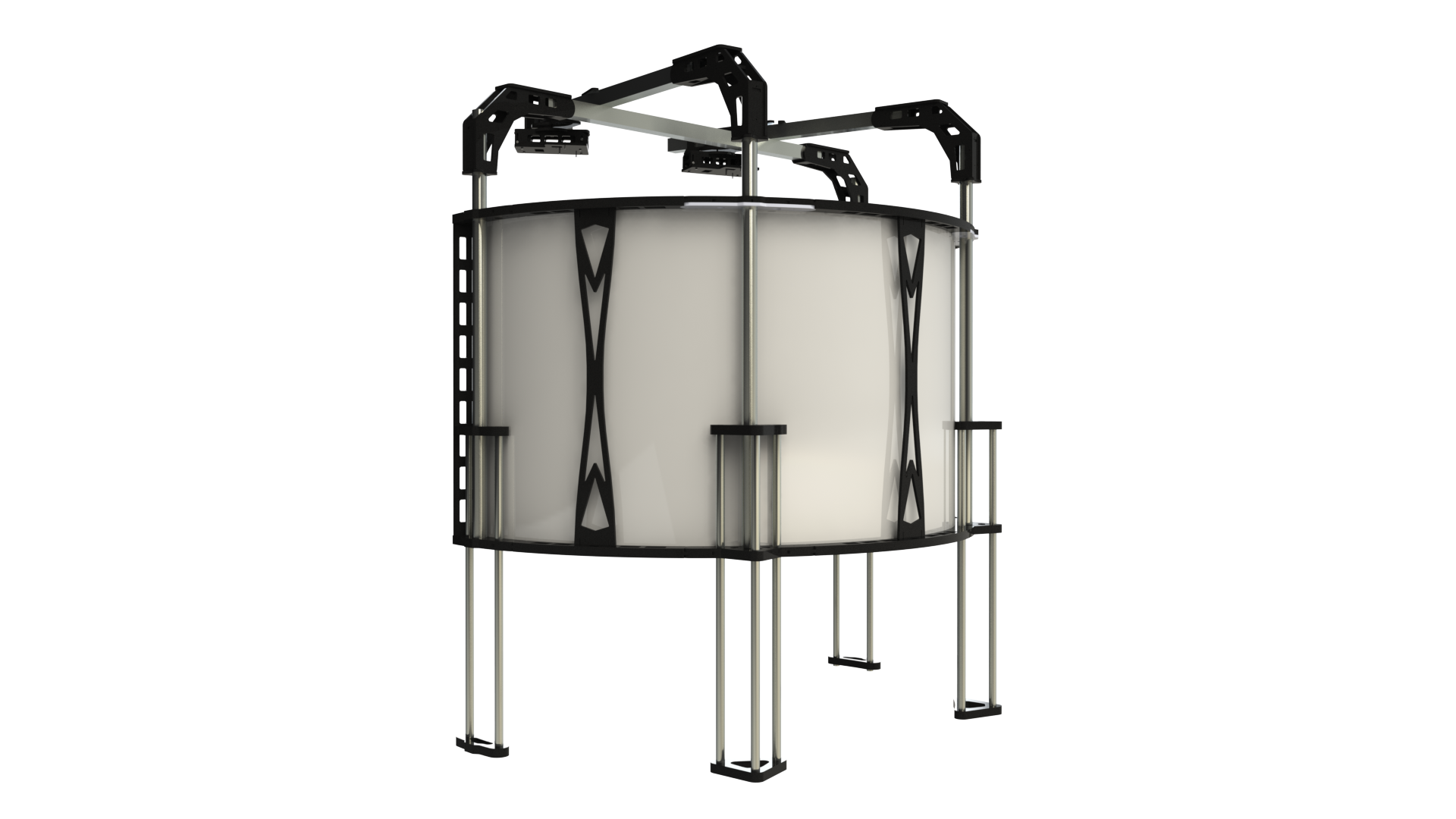
A SimPit system is a floor-standing frame a homeowner can position, projectors included in the power budget of a gaming PC, and heat sources mounted away from the seat. It ships in crates and assembles without a contractor.
Where an LED wall is the right call
Bright, uncontrolled ambient light all day, flat content on a flat wall, outdoor visibility, broadcast backdrops — LED earns its keep there, and we'll tell you so. Our ALR surface narrows that gap indoors, but a daylight-flooded showroom wall is LED territory.
A simulator is the opposite brief: a controlled room, a curved field of view, a seated eye point at arm's length, and hours in the seat. That's the brief this screen was engineered for.
Send us the LED quote you're weighing up.
We'll spec the equivalent SimPit system for your room and put the numbers side by side — geometry, resolution at your eye point, power, and price.
Get the comparison